
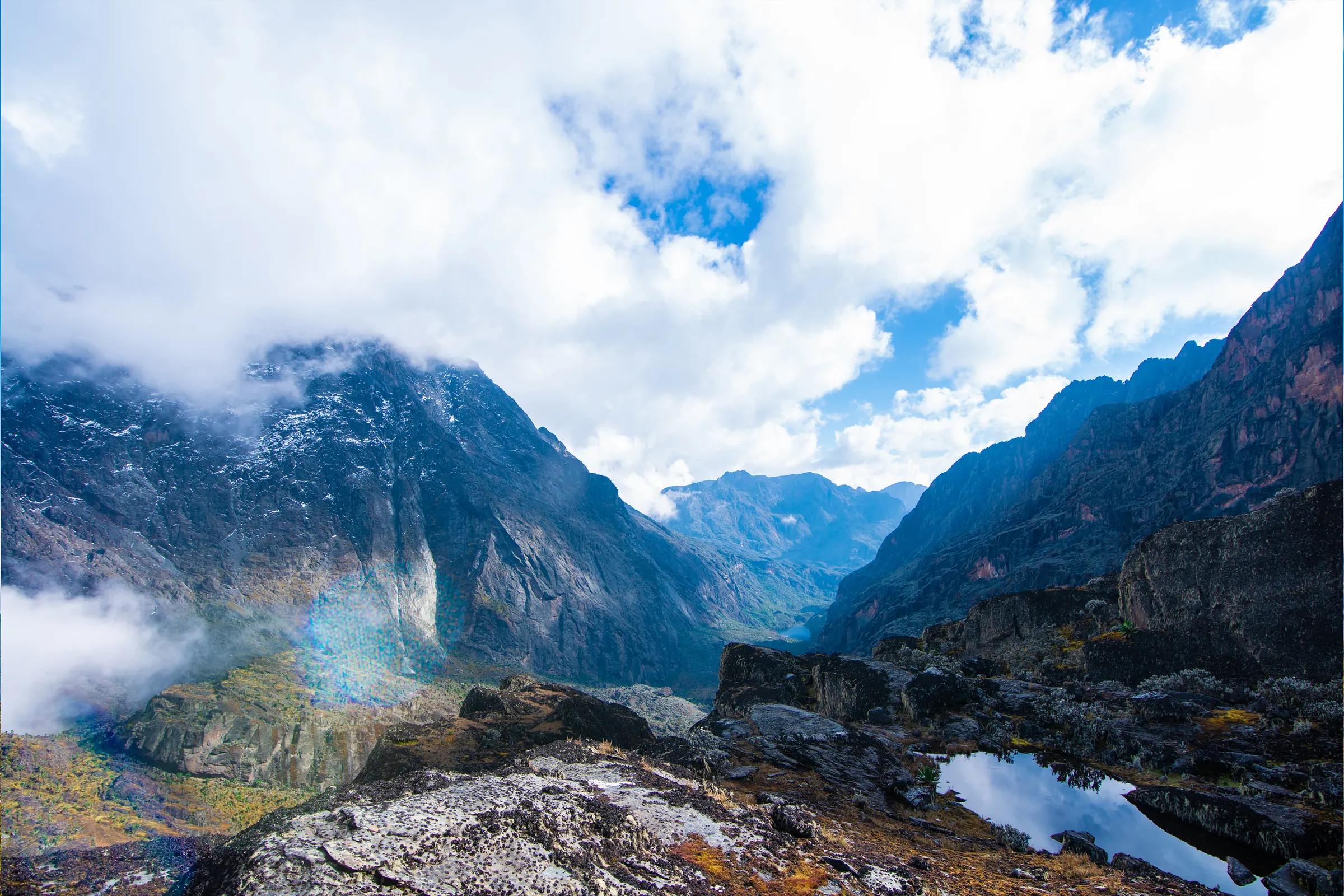
Rwenzori Vegetation Zones
The Rwenzori's vegetation is the reason a lot of people come here rather than to Kilimanjaro, and it is the thing photographs consistently fail to prepare you for. The park protects five distinct vegetation zones, and you pass through all of them on a summit trek — from closed rainforest to bare rock and ice, in the space of a few days' walking.
The World Heritage assessment describes the flora here as the richest montane flora in Africa, and calls the giant heathers, groundsels and lobelias the continent's botanic big game. That phrase does a lot of work. These are not unusual versions of familiar plants. They are familiar plants at sizes that stop making sense.
Montane forest
The lowest zone, and where every trek starts. Closed-canopy forest, dense understorey, mud underfoot from the first hour. It is warm, humid and loud with birds and insects. Visibility is short. Most of the wildlife in the park lives here, and most of it you will not see.
This is also where people form their first impression of the trek, and it is a misleading one. The forest is hard walking but it is not what the mountain has in store.
Bamboo
A transitional belt above the forest. Bamboo stands can be dense enough to close over the trail entirely, and the ground beneath them is frequently saturated. Where bamboo has fallen, the walking gets awkward.
Heather and moorland
This is where the Rwenzori starts to look like nowhere else.
Tree heathers — Erica — grow here to heights that would be absurd anywhere else, with rust-coloured peeling bark, hung with pale beard lichen that drips constantly in the mist. The ground between them is moss and bog. Walking through a heather zone in cloud is the single most distinctive experience the mountain offers, and it is what most people mean when they describe the Rwenzori as otherworldly.
Expect to be wet. The moss holds water, the lichen holds water, and the cloud sits in this zone most days.
Afro-alpine
Above the heather. Open ground, giant groundsels standing like small trees, and giant lobelias — the plants the range is famous for — rising in columns above the moss and tussock.
The bogs here are the ones people warn each other about. Between camps on the high circuits you can be on saturated ground for hours, and it does not dry out because the landform holds water. This is not a wet-season problem. It is the zone.
Temperatures drop sharply and the daily swing widens. Cold nights, and sun that burns when the cloud breaks.
Nival
Bare rock, snow and ice at the top of the range. Sparse vegetation giving way to nothing. This is summit-day terrain rather than a zone you camp in.
Why the plants grow so large
The short answer is stable conditions and no competition.
Equatorial high-altitude sites do not have a growing season in the way temperate mountains do. Day length barely varies, and the temperature cycle is daily rather than seasonal — cold nights, warm days, all year. Plants adapted to that can keep growing continuously instead of shutting down each winter. Add high rainfall, high UV, and very few competitors able to tolerate the conditions, and you get lobelias taller than a person.
The insulating structures are worth looking at closely when you pass them: the dense rosettes and dead leaf skirts on the groundsels are frost protection, holding heat around the growing tip through the night.Your guide will tell you as you cross between zones — the change is usually obvious underfoot before it is obvious in the vegetation. We would rather give you the crossing points from the trail than from a textbook.