How Difficult Is Rwenzori Trekking?
Harder than most people expect. Not harder than you can do, if you prepare for the right things.
The useful answer is not a single rating out of five, because the Rwenzori is difficult in four separate ways and most people underestimate three of them while worrying about the wrong one.
The four difficulties
The wet. This is the one nobody prepares for. The Rwenzori is exceptionally wet in every month of the year. "Drier season" here means less rain, not no rain, and the ground does not dry out regardless. You should plan on being wet for most of the trek and on nothing you are carrying drying out overnight. Trekkers who have done Kilimanjaro are frequently caught out by this, because Kilimanjaro is a dry mountain by comparison.
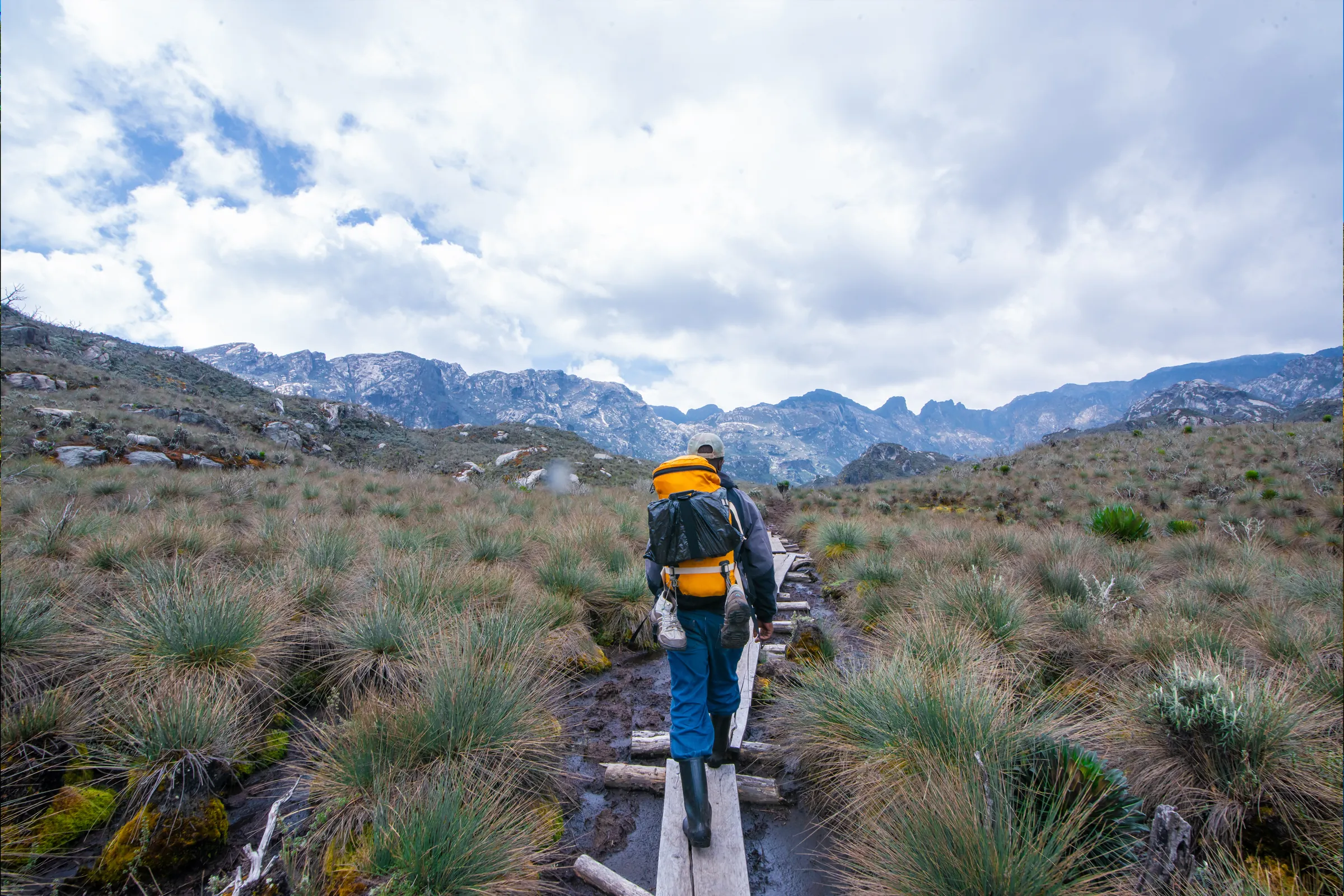
The bog. Between camps in the heather and alpine zones you will be on saturated ground, tussock and deep mud for hours at a time. It is slow, it is tiring in a way flat distance does not convey, and it is a permanent feature of the landform rather than a seasonal condition. Walking speed on bog bears no relationship to your speed on a path.
The terrain. The Rwenzori is a fault-uplifted block, not a volcano, so it does not offer the long even gradients of Kilimanjaro. Days involve substantially more ascent and descent than the net altitude change suggests, over steep, wet, root-tangled and rocky ground. Poles help. Ankle strength helps more.
The altitude. Margherita Peak is 5,109 metres. Everything the altitude does to people on any high mountain, it does here. What differs is that the acclimatisation profile depends heavily on which route and which itinerary you take, and shorter is not always better value for the money.
What is genuinely technical
Only the final section of a Margherita attempt. That involves glacier travel with rope and crampons, and it is the reason Margherita sits in a different category from every other summit in the range.
Everything below that is hard walking and scrambling, not climbing. If glacier work is not something you want, there are real alternatives here — Weismann Peak, Mount Baker, the high viewpoints — and choosing one of them is not a lesser trip.
Compared with Kilimanjaro
Kilimanjaro is higher. The Rwenzori is harder.
On Kilimanjaro you walk on dry paths at moderate gradient to a higher altitude, with substantial infrastructure and a large industry around you. On the Rwenzori you cross bog and steep wet ground to a slightly lower altitude, in worse weather, with far fewer people, and the summit needs equipment Kilimanjaro's does not.
If altitude is your limiting factor, Kilimanjaro is the harder day. If you are worried about ground conditions, sustained discomfort and consecutive hard days, the Rwenzori is the harder week.
Who turns back
People turn back on this mountain for four reasons, in roughly this order: altitude symptoms, weather closing the summit window, underestimating the cumulative effect of consecutive wet days, and footwear or gear that failed early.
Three of those four are addressable before you leave home.
We do not publish a summit success rate. We do not have data we would stand behind, and the figures you will see quoted elsewhere on this subject are — as far as we can tell — not derived from anything either.
What actually prepares you
Not gym cardio. Consecutive long days on unstable, wet ground, carrying a daypack, in bad weather, deliberately.
If you can do three consecutive six-hour hill days in the rain and feel ready to do a fourth, you are in the right territory. Details are on our fitness and training page.
Difficulty by trek
The three and four day treks reach the forest and lower alpine zones with no altitude risk and no technical ground. Six-day itineraries reach serious altitude on walking terrain. Eight and nine day itineraries are summit attempts with glacier work on the final day. The twelve-day expedition is the hardest thing we run and has prerequisites rather than aspirations attached to it.